The 2026 hospice cap year closed on September 30. Over the next few months every Medicare-certified hospice in the country will calculate whether its total Medicare payments for that year ran past the hospice aggregate cap, and the ones that did will write a check back to the program. For an owner who plans to sell in the next one to three years, that calculation is more than a compliance chore. It is usually the first liability a buyer looks for, and the way it is handled can move a purchase price by more than any multiple debate.
This guide explains how the hospice aggregate cap works, how often hospices actually exceed it, why location changes the math, and how buyers turn cap exposure into price, escrow and deal terms. It closes with a preparation checklist you can start this quarter.
Key takeaways
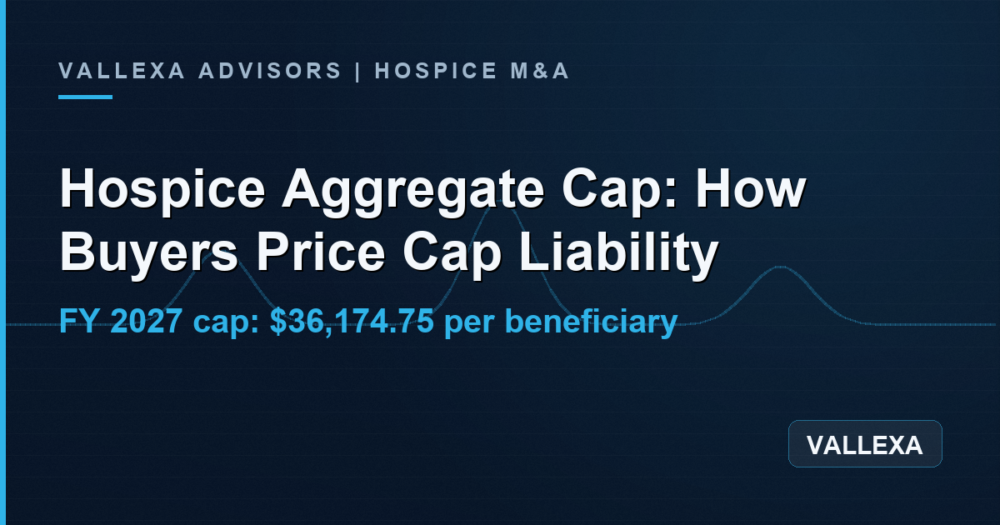
- The hospice aggregate cap for the cap year that began October 1, 2026 is $36,174.75 per beneficiary, up 2.3 percent from $35,361.44, per the FY 2027 Hospice Wage Index and Payment Rate Update final rule (91 FR 49118).
- Under 42 CFR 418.308(c), a hospice must file its self-determined cap calculation no later than five months after the cap year ends and pay any overpayment at that time. For the year that closed September 30, 2026, that means by the end of February 2027.
- MedPAC’s March 2026 report estimates that about 28 percent of hospices exceeded the cap in 2023, up from 19 percent in 2019 through 2021, and that each one exceeded it by about $410,000 on average.
- Buyers rebuild your cap position from claims data, treat open cap years as a liability that follows the provider number, and price the gap with a holdback, an escrow or a lower headline number.
- Owners who track the cap monthly and can show length of stay and live discharge trends by referral source close faster and keep more of the price.
What is the hospice aggregate cap?
The hospice aggregate cap is a limit on the total Medicare payments one hospice can keep in a cap year. It is not applied to each patient. As MedPAC describes it, each hospice’s aggregate payments are capped at its number of Medicare patients in the year multiplied by the cap amount. If total payments run past that figure, the hospice repays the difference.
Three features of the cap matter most for a sale.
First, it is an aggregate test. A hospice can serve many long-stay patients and stay under the cap as long as enough short stays balance them out. The census mix, not any one patient, decides the result.
Second, the cap is not adjusted for local wages. The daily hospice rates carry a wage index, but the cap amount is the same national dollar figure everywhere. MedPAC notes that the 2026 cap of $35,361 equals the Medicare payment for a routine home care stay of about 178 days at a wage index of 1.0. In a market with a wage index well above 1.0, each day of care pays more, so the same cap is reached in fewer days.
Third, the cap is reset every year by statute. CMS does not have discretion over the update method. In the FY 2027 final rule, CMS states it is required by law to update the cap by the hospice payment update percentage and lacks authority to replace the cap or adjust it geographically, and the Consolidated Appropriations Act, 2026 extended that update method through cap years ending before October 1, 2035.
| Cap year | Period | Cap amount per beneficiary | Source |
|---|---|---|---|
| FY 2026 | October 1, 2025 to September 30, 2026 | $35,361.44 | FY 2027 final rule, 91 FR 49118 |
| FY 2027 | October 1, 2026 to September 30, 2027 | $36,174.75 (up 2.3 percent) | FY 2027 final rule, 91 FR 49118 |
The 2026 cap year just closed: the dates that matter
The rules for reporting the cap sit in 42 CFR 418.308. Paragraph (c) sets three requirements:
- The hospice files its aggregate cap determination with its Medicare contractor no later than five months after the end of the cap year and remits any overpayment at that time.
- The calculation must use data no earlier than three months after the end of the cap period, so that late claims are in the numbers.
- If the hospice does not file within five months, Medicare payments to the hospice are suspended in whole or in part until it does.
For the cap year that ended September 30, 2026, the earliest data date falls at the end of December 2026 and the filing deadline falls at the end of February 2027. Paragraph (d) of the same section states plainly that payments above the cap are overpayments and must be refunded.
The filing is not the end of the story. MedPAC notes that Medicare claims-processing contractors may reopen the cap calculation for up to three years, and that the timing of reopening varies by contractor. A buyer reading that sentence hears one thing: up to three prior cap years may still be open, and any of them can produce a new demand after closing.
That is why timing matters if you are preparing to sell in 2027. A deal that closes in the spring will land after your FY 2026 filing, which is good, because the buyer will see a filed number instead of an estimate. A deal that closes in January will land in the gap between year end and filing, and the buyer will price an estimate with a margin for error.
How often do hospices exceed the cap?
More often than most owners assume, and the trend has been rising. MedPAC’s March 2026 report to Congress, Table 10-5, shows the share of hospices it estimates exceeded the cap in each year:
| Cap year | Share of hospices over the cap | Average overage per hospice over the cap | Overage as a share of Medicare hospice spending |
|---|---|---|---|
| 2019 | 19% | $384,000 | 1.7% |
| 2020 | 19% | $422,000 | 1.8% |
| 2021 | 19% | $451,000 | 2.0% |
| 2022 | 23% | $419,000 | 2.3% |
| 2023 | 28% | $410,000 | 2.9% |
Source: MedPAC, March 2026 Report to the Congress, Chapter 10, Table 10-5. MedPAC notes its estimates may differ from contractor figures.
MedPAC also estimates that the 28 percent of hospices over the cap in 2023 cared for only about 8 percent of hospice patients. Above-cap hospices tend to be smaller. That fits what buyers see in practice: a smaller agency with a long average length of stay is the profile most likely to carry a repayment, and it is also the profile most often brought to market.
An average overage of about $410,000 is not a rounding error for a hospice of that size. For many small agencies it is a large share of a year’s earnings, and it is a cash payment due within months of year end.
Why location changes the math
MedPAC finds that hospices over the cap are concentrated in four states: Arizona, California, Nevada and Texas. Its estimates for 2023:
- More than half of hospices in California exceeded the cap.
- Roughly 30 to 40 percent of hospices in Texas, Nevada and Arizona exceeded it.
- Outside those four states, about 6 percent of hospices exceeded the cap, up slightly from 5 percent in 2022.
MedPAC ties the pattern to rapid entry of new providers in those states through 2023, and notes that CMS began enhanced oversight of newly enrolling hospices in the four states in mid-2023.
For an owner in one of these states, the practical point is simple. Buyers start from the assumption that your agency could be over the cap, because the state base rate says so. You remove that assumption with documents, not with reassurance. For an owner elsewhere, a clean cap history is a selling point worth stating early, because a buyer comparing agencies will notice it.
None of this says anything about any individual agency. Plenty of hospices in all four states run well under the cap. The base rate simply sets the buyer’s starting question.
What the cap does to margin, and why buyers care
The most useful MedPAC figure for a seller is the margin comparison. For 2023, MedPAC estimates:
- Hospices below the cap had an aggregate fee-for-service Medicare margin of 9.0 percent.
- Hospices above the cap had a margin of 17.8 percent before returning overpayments.
- After returning overpayments, the same above-cap group had an estimated margin of minus 1.4 percent.
Read that again from a buyer’s chair. An agency over the cap can show the strongest margin in its market on a profit and loss statement that has not yet booked the repayment. Once the repayment is booked, the margin can turn negative. A buyer who values the first number and pays for it inherits the second.
That is why experienced buyers do not take reported earnings at face value in hospice. They normalize earnings for cap repayments year by year, and they ask whether the census that produced those earnings can continue without producing another repayment.
How buyers turn cap exposure into price
Buyers handle cap exposure in four ways, usually in combination.
They rebuild your cap position themselves. A buyer’s diligence team will compare Medicare payments by cap year with your beneficiary counts and the cap amount for each year. They will ask for the self-determined cap filings, any contractor determination letters and the claims data behind them. If their number differs from yours, expect a conversation about method, including how beneficiaries are counted. MedPAC’s own estimates assume the proportional method, and the method used affects the result.
They treat open cap years as a liability that follows the provider number. Under 42 CFR 489.18, when a change of ownership occurs the existing Medicare provider agreement passes automatically to the new owner, subject to all applicable statutes and regulations, and a transfer of corporate stock is not a change of ownership at all. Buyers therefore assume that cap overpayments for prior years can follow the agency into their hands. How your specific structure allocates that risk is a question for your healthcare attorney, but you should expect the buyer to raise it.
They hold money back. The common tools are an escrow or holdback sized to the estimated exposure for open cap years, a specific indemnity for cap overpayments that survives closing, and a working capital adjustment that treats an accrued but unpaid repayment as debt. The size of the holdback depends on how confident the buyer is in your numbers. Clean, reconciled cap files shrink it.
They adjust the price or walk. If the agency’s earnings depend on a census that runs over the cap every year, a buyer will price the business on earnings after repayment, which can cut value sharply. If the exposure cannot be estimated with confidence, many buyers will pass rather than guess.
Length of stay and live discharge: the cap’s early warning
MedPAC reports that hospices above the cap have substantially longer stays and higher live discharge rates than hospices below it, even for patients with similar diagnoses. Buyers use those two measures as an early warning for future cap exposure, and also as a compliance signal, because MedPAC states that the pattern suggests some above-cap hospices are admitting patients who do not meet eligibility criteria.
This is where an owner can do the most good before a sale. If your average length of stay is long for a legitimate reason, such as a high share of dementia patients referred by long-term care partners, document it. Show length of stay and live discharge by diagnosis and by referral source, show that your eligibility documentation holds up on audit, and show how your admissions mix has changed. A buyer who can see the reason behind the number will price the reason. A buyer who sees only the number will price the risk.
Our earlier guide on the quality file buyers read before they call you covers the public quality data that buyers pair with these measures.
What to prepare before you go to market
Start this list now, even if a sale is two years away. Every item reduces the holdback a buyer will ask for.
- Every cap filing for open years. Collect the self-determined cap filing for each of the last three cap years at minimum, the contractor’s determination letter for each, and proof of payment for any overpayment.
- Any repayment plan. If you are repaying an overpayment over time, have the agreement and the current balance ready. An undisclosed repayment plan found in diligence does more damage than the debt itself.
- A monthly cap tracker. Track beneficiaries, Medicare payments and the running cap position by month for the current cap year. A buyer who sees you managing the cap in real time worries less about the next filing.
- An estimate for the year that just closed. Until your FY 2026 filing is made, prepare a careful estimate using the cap amount of $35,361.44 and claims data that is as complete as possible, and say clearly that it is an estimate.
- Length of stay and live discharge detail. Break both out by diagnosis, referral source and level of care, with a short written explanation of any trend.
- Eligibility documentation. Be ready to show how certifications of terminal illness and recertifications are reviewed, and the results of any internal or external audits.
- Earnings normalized for the cap. Present earnings for each year after cap repayments, not before. If you present the higher number, the buyer will restate it for you, and you lose credibility on every other figure.
Our exit preparation guide has a longer checklist for the year before going to market.
If your agency is over the cap today
Being over the cap does not make an agency unsellable. It changes who buys it and how the deal is built. Some buyers value a license, an accreditation and a referral base, and they plan to change the census mix after closing. Those buyers will still discount for open cap years, but they are pricing a different business plan than yours.
What hurts sellers is surprise. An owner who discloses the exposure early, with filings, a repayment history and a clear account of why the census looks the way it does, keeps control of the negotiation. An owner whose buyer finds the exposure in diligence usually loses that control, and often the deal.
How Vallexa presents hospice cap history to buyers
Every opportunity we bring to market stays anonymous until a buyer authorizes a nondisclosure agreement. Cap filings, determination letters and a normalized earnings bridge go into the confidential materials alongside the financials, so a qualified buyer can compare agencies on the same basis instead of guessing. You can see how we present a hospice without revealing its identity on current listings such as this Northern Nevada hospice in Washoe County, this Metro Atlanta Medicare-certified hospice and this San Diego hospice license. For more on how we value and sell agencies, see our hospice valuation and selling guide.
Frequently asked questions
The hospice aggregate cap limits the total Medicare payments a hospice can keep in a cap year. It equals the hospice’s number of Medicare beneficiaries in the year multiplied by the cap amount, which is $36,174.75 for the cap year that began October 1, 2026. Payments above that total are overpayments the hospice must repay.
Under 42 CFR 418.308(c), a hospice must file its self-determined aggregate cap calculation with its Medicare contractor no later than five months after the cap year ends, using data no earlier than three months after the cap year ends, and pay any overpayment at that time. For the cap year that ended September 30, 2026, the filing is due by the end of February 2027.
MedPAC’s March 2026 report estimates that about 28 percent of hospices exceeded the aggregate cap in 2023, up from 23 percent in 2022 and 19 percent in 2019 through 2021. Those hospices cared for about 8 percent of hospice patients and exceeded the cap by about $410,000 each on average.
Under 42 CFR 489.18, a change of ownership passes the existing Medicare provider agreement automatically to the new owner, subject to all applicable statutes and regulations, and a stock purchase is not a change of ownership at all. Buyers therefore assume cap overpayments for open years can follow the agency, and they protect themselves with escrows, holdbacks or indemnities. Confirm the treatment for your deal structure with your healthcare attorney.
Track the cap position monthly, file every self-determination on time, keep determination letters and proof of payment for at least the last three cap years, present earnings after cap repayments, and document length of stay and live discharge by diagnosis and referral source so a buyer can see the reason behind the numbers.
The bottom line
The hospice aggregate cap is one of the few parts of a hospice valuation that a buyer can estimate from your own claims before the first meeting. It is also the part most likely to turn a strong profit and loss statement into a weak one. Owners who file on time, track the cap every month and can explain their length of stay walk into diligence with answers instead of a surprise.
If you are considering a sale in the next one to three years and want a confidential view of how your cap history affects value, contact Vallexa Advisors.
Sources
- Centers for Medicare and Medicaid Services, Medicare Program; FY 2027 Hospice Wage Index and Payment Rate Update and Hospice Quality Reporting Program Requirements, final rule, 91 FR 49118, August 3, 2026, section III.A.4.
- Medicare Payment Advisory Commission, March 2026 Report to the Congress: Medicare Payment Policy, Chapter 10, Hospice services, including Table 10-5.
- Electronic Code of Federal Regulations, 42 CFR 418.308, Limitation on the amount of hospice payments.
- Electronic Code of Federal Regulations, 42 CFR 489.18, Change of ownership or leasing: Effect on provider agreement.
This article is general information for business owners, not legal, tax or reimbursement advice. Confirm how the cap applies to your agency with your Medicare reimbursement specialist and healthcare attorney.