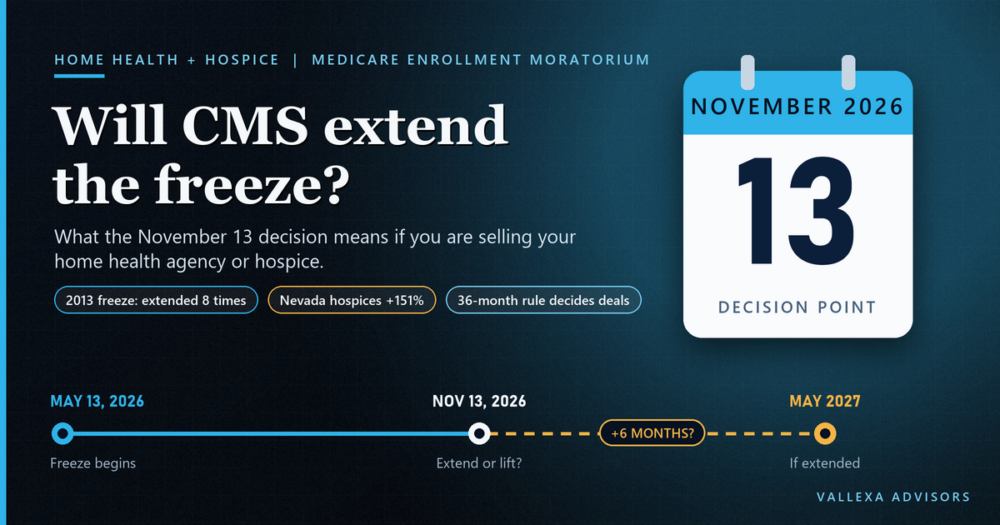
If you are thinking about selling your home health agency or selling your hospice, one date now sits over every conversation you will have with a buyer: November 13, 2026. That is when the first six-month period of the nationwide Medicare enrollment moratorium on home health agencies (HHAs) and hospices runs out, and when CMS has to decide whether to extend it, change it or let it lapse.
As of October 21, 2026, CMS has not said which way it will go. No extension notice and no lifting notice has appeared in the Federal Register. But the record CMS wrote in May says a lot. This guide walks through how the home health and hospice moratorium extension decision works, what CMS’s own documents suggest about the outcome, and what each outcome means for an owner who wants to sell in the next year.
Key takeaways
- The home health and hospice moratorium took effect May 13, 2026, for six months, and “may be extended in 6-month increments” if CMS deems it necessary, per the HHA notice (FR Doc. 2026-09717) and the hospice notice (FR Doc. 2026-09718). An extension and a lift are both announced by Federal Register notice.
- As of October 21, 2026, a search of the Federal Register shows no extension or lifting notice, and the CMS Provider Enrollment Moratoria page still lists the freeze as active.
- The last time CMS froze home health enrollment, a July 2013 moratorium was extended eight times between February 2014 and July 2017 and did not expire until January 30, 2019. CMS wrote in May that it found those moratoria beneficial, “which is largely why we extended and expanded them over a 5-year period.”
- The data CMS used to justify the freeze has not changed: enrolled hospices in Nevada rose 151 percent from 2019 to 2023 and California rose 126 percent (1,130 to 2,559), and 122 of about 670 hospices placed under medical review had been revoked as of June 2025, an 18 percent rate against a typical 1 to 3 percent.
- The one counterweight: a separate six-month moratorium on DMEPOS medical supply companies took effect February 27, 2026, and CMS’s moratoria page no longer lists it as active. We found no Federal Register notice extending it.
- Whatever CMS decides, the rule that decides most deals is the 36-month rule. A change in majority ownership inside 36 months of initial enrollment or the last ownership change requires a new enrollment, which the freeze blocks.
Where the moratorium stands today
Two Federal Register notices published May 15, 2026 created the freeze: one for home health agencies and one for hospices. Both took effect May 13, 2026. CMS’s HHA and hospice moratorium FAQs (last revised July 9, 2026) say the freeze “applies to initial applications and includes non-exempt changes in majority ownership (CIMOs) under 42 CFR 424.550(b).” Any initial application submitted after the start date is denied.
The freeze does not stop existing agencies from operating, billing or being bought. It stops new Medicare enrollments, and it stops existing agencies from adding new branches or practice locations. CMS’s FAQs say enrolled providers “can acquire and merge with other enrolled providers during the moratorium,” as long as no change in majority ownership requires a new enrollment and no new locations are added.
On the public calendar, the first six-month period ends on or about November 13, 2026. Here is what the record shows as of October 21:
| Item | Status on October 21, 2026 | Source |
|---|---|---|
| Moratorium start date | May 13, 2026 | FR Docs. 2026-09717 and 2026-09718 |
| Length of first period | 6 months, extendable in 6-month increments | Same notices |
| Extension notice published | None found | Federal Register document search |
| Lifting notice published | None found | Federal Register document search |
| CMS moratoria page | Lists the HHA and hospice freeze as the active moratorium; last modified August 27, 2026 | CMS Provider Enrollment Moratoria page |
| CY 2027 home health final rule | At OIRA since September 21, 2026, not yet published | OIRA review record for CMS-1844 |
How CMS decides whether to extend the moratorium
The moratorium authority sits in 42 CFR 424.570. Both May notices describe the same process. CMS “evaluates whether to extend or lift the moratorium before the end of the initial 6-month period,” and if the moratorium is extended, CMS “will publish a document regarding such extension(s) in the Federal Register.” CMS’s FAQs add that the lifting of the moratorium “will also be announced through an FR notice.”
Three practical points follow for a seller:
- The announcement can come late. Nothing in the notices sets a deadline for publishing an extension before the period ends. In the last cycle, the first period of the July 31, 2013 moratorium ran to the end of January 2014, and the extension notice was dated February 4, 2014.
- An extension does not have to look the same. In 2014 and 2016, CMS extended its earlier moratoria and changed their scope at the same time, adding counties and later whole states. A November decision could narrow the freeze to certain states, widen it, or keep it nationwide.
- A lift does not mean a flood of new competitors. Both notices say that once a moratorium is lifted, providers that could not enroll will be assigned the “high” screening level if they apply within six months of the lift. High screening means a site visit and fingerprint-based background checks for owners of 5 percent or more. New entrants would return slowly.
Signals that point toward an extension
Nobody outside CMS knows the answer, and an advisor who tells you otherwise is guessing. But CMS has put a great deal on the public record, and most of it leans one way.
CMS’s own history. The July 31, 2013 moratorium on new home health agencies in the Miami and Chicago areas was extended in February 2014, August 2014, February 2015, July 2015, February 2016, August 2016, January 2017 and July 2017, and expanded statewide in Florida, Illinois, Michigan and Texas along the way. It expired on January 30, 2019. In the May 2026 HHA notice, CMS described that experience in plain terms: “We found our previous HHA moratoria beneficial in this regard, which is largely why we extended and expanded them over a 5-year period.”
The data behind the freeze has not gone away. CMS’s hospice notice includes a table of enrolled hospices from 2019 to 2023:
| State | Enrolled hospices, 2019 | Enrolled hospices, 2023 | Increase |
|---|---|---|---|
| Arizona | 152 | 311 | 105% |
| California | 1,130 | 2,559 | 126% |
| Nevada | 55 | 138 | 151% |
| Texas | 718 | 1,081 | 51% |
The same notice says Nevada hospices kept rising, from 138 in 2023 to 188 in 2025, and that Georgia went from 221 hospices in 2019 to 273 in 2025 while its Medicare beneficiaries grew only 6 percent. Under CMS’s hospice medical review initiative, about 670 hospices had been placed under review as of June 2025 and 122 had been revoked. CMS called that 18 percent revocation rate “far more than the average revocation rate of about 1 to 3 percent.” On the home health side, CMS wrote that Los Angeles County holds roughly 12 to 15 percent of all HHAs nationwide while representing roughly 3 percent of Medicare beneficiaries. Six months of frozen enrollment does not change any of those numbers.
CMS is writing moratoria into its rules. The CY 2027 home health proposed rule (FR Doc. 2026-13602) proposes changes to 42 CFR 424.570. CMS wrote: “Since restarting the moratorium process in 2026 after more than 6 years, we have seen several issues that we believe must be addressed in regulation.” One proposal would set a moratorium’s effective date as the day its notice is filed for public inspection, so applicants cannot rush in before the notice publishes. Another would confirm that ownership changes requiring an initial enrollment count as “new” enrollments under a moratorium. An agency that expected to stop using the tool would have less reason to tighten it.
Enforcement authority is consolidating at CMS. On October 14, 2026, HHS published a Statement of Delegation of Authority (FR Doc. 2026-21001) giving the CMS Administrator formal permissive exclusion authority under section 1128(b) of the Social Security Act. The notice says CMS requested it and that it “aligns investigative and enforcement responsibilities within a single operating division.” It is not a moratorium decision, but it points the same direction.
The access cost looks small to CMS. In both notices CMS estimated how many enrollments the freeze would block. For hospices outside the five fastest-growing states, new enrollments ran roughly 500 between 2023 and 2025, or 166 a year. For home health outside California, new enrollments were generally under 400 a year, against “over 11,500 HHAs nationwide.” CMS called the blocked number “a miniscule percentage” of the more than 2 million enrolled Medicare providers and suppliers. If CMS sees little access cost, it has little reason to hurry.
Signals that point toward a lift or a narrower freeze
The case on the other side is real, and a seller should weigh it.
The 2026 DMEPOS freeze. In February 2026, CMS imposed a six-month nationwide moratorium on new DMEPOS medical supply companies (FR Doc. 2026-03971), effective February 27, 2026. Its first period ran out at the end of August. CMS’s moratoria page, last updated August 27, 2026, now lists only the HHA and hospice freeze as active, and we found no Federal Register notice extending the DMEPOS freeze. It is the only 2026 moratorium to reach its first decision point so far, and it was not extended.
The 2013 program was geographic. The earlier freezes targeted specific counties and states. This one is nationwide. CMS could decide that the strongest evidence is concentrated in a handful of states, the same ones in its own tables, and narrow the freeze rather than end it.
Weighing both sides, the more likely outcome on the public record is an extension in some form. Plan your sale so it works either way.
Extended or lifted: what each outcome means for a seller
| Question | If the freeze is extended | If the freeze is lifted |
|---|---|---|
| Can a new competitor enroll? | No, for at least six more months | Yes, but under high-risk screening for six months, with site visits and fingerprinting |
| Value of an existing Medicare enrollment | Stays scarce: buyers cannot start an agency instead of buying one | Scarcity eases over time as new enrollments resume |
| Seasoned agency (past 36 months) | Equity sale closeable; buyer pool includes anyone shut out of new enrollment | Equity sale closeable; some buyers may choose to start from scratch |
| Agency inside the 36-month window | Ownership change requiring a new enrollment cannot be completed | New enrollment path reopens, with survey or accreditation and high-risk screening |
| Adding branches after closing | Not allowed during the freeze | Allowed again |
| Timeline risk | Known: the rules stay as they are | Some buyers wait to see how many new agencies enroll |
The pattern is simple. An extension tends to help owners of seasoned agencies, because it keeps the market for existing enrollments closed to new supply. A lift helps owners whose agencies cannot change hands today. Most sellers fall clearly into one group, and the 36-month date tells you which.
Selling your home health agency during the moratorium
If you are selling a home health agency, three facts set your options.
Your 36-month date. Under 42 CFR 424.550(b), a home health agency that undergoes a change in majority ownership within 36 months of its initial enrollment or its most recent change in majority ownership must enroll as a new provider and obtain a new survey or accreditation. CMS’s FAQs list asset sales, stock transfers, mergers and consolidations as changes in majority ownership. During the freeze, that new enrollment is blocked. Confirm your initial enrollment date and the date of any later ownership change in writing before you start a process.
Your structure. For agencies past 36 months, buyers generally prefer an equity purchase so the existing enrollment and CMS Certification Number stay in place. Stock and asset deals are processed differently, so have your healthcare attorney confirm that the structure you choose will not require a new enrollment while the freeze lasts.
Your branches. Buyers who planned to grow by adding branches cannot do that while the freeze lasts. Existing locations transfer with the agency in an acquisition, but new ones cannot be added. Agencies that already hold the locations a buyer wants are worth more to that buyer during a freeze.
If you are past 36 months, there is no reason to wait for November. Your deal can close under either outcome. Our home health agency valuation and sale guide explains how buyers price the rest of the business.
Selling your hospice during the moratorium
Hospices face the same freeze with two additions.
The 36-month rule now covers hospices. CMS’s hospice notice explains that it extended the 36-month rule to hospices to support a full review of new owners. Hospices are also in CMS’s high-risk screening category, so a new owner faces a site visit and fingerprinting of 5 percent or greater owners.
State rules can stack on top. CMS’s FAQs leave Medicaid moratoria to each state, and some states run their own licensing or Medicaid freezes alongside the federal one. A buyer has to clear every layer, and each one adds time to a closing.
Your cap and quality file matter more when the buyer pool is narrow. With new enrollment blocked, a hospice buyer is choosing among existing agencies, and the best files win. Our guides on the hospice aggregate cap and the quality file buyers read cover what to prepare, and our hospice valuation and selling guide covers the rest.
The 36-month rule decides most deals, not November
It is easy to treat November 13 as the date that matters most. For most sellers it is not. The 36-month date decides whether a deal can close at all while the freeze runs, and it does not move with CMS’s decision.
The exceptions to the 36-month rule are narrow and fact-specific. 42 CFR 424.550(b)(2) lists them: an agency that has submitted two consecutive years of full cost reports since its initial enrollment or last ownership change (low or no utilization reports do not count), an internal corporate restructuring of a parent company, a change in business structure where the owners stay the same, and the death of an owner. Confirm with your healthcare attorney whether any exception applies to you before you rely on it.
For background on how the freeze started and what we said at its first milestones, see our May overview of the six-month moratorium, our August piece on the first decision point in November, and our October 19 update, about 25 days to the freeze decision.
A seller’s checklist for the next 30 days
- Pull your enrollment history. Get your initial Medicare enrollment date, your CMS Certification Number, and the date of every change in majority ownership. Your 36-month status follows from these dates.
- Map your ownership. List every owner of 5 percent or more and every indirect owner. Buyers and CMS will screen them.
- List your locations. Document every branch and practice location already on your enrollment. During a freeze, these are the only locations a buyer can get.
- Check your state. Find out whether your state runs its own licensing or Medicaid moratorium, and how it treats changes of ownership.
- Pick a structure that works under both outcomes. For seasoned agencies, that is usually an equity sale. Confirm it with your healthcare attorney.
- Prepare your file now. Financials, survey history, payer mix and quality data take longer to assemble than most owners expect. A buyer who has the file in November can move in either scenario.
- Watch the Federal Register in the week of November 13. Either decision will appear there, and we will publish an update when it does.
Our exit preparation guide has a longer checklist for the year before you sell.
How buyers are reading the freeze right now
While the freeze lasts, a buyer who wants into home health or hospice has to buy an existing agency. You can see how we present agencies without revealing their identity in current listings such as this San Diego home health agency, 36-month exempt, this Toledo, Ohio home health agency, this Conejo Valley, California hospice, moratorium and 36-month rule exempt, and this Metro Atlanta Medicare-certified hospice.
Frequently asked questions
CMS has not announced a decision. The nationwide moratorium took effect May 13, 2026 for six months and may be extended in six-month increments. As of October 21, 2026, no extension or lifting notice had appeared in the Federal Register. CMS’s own record leans toward an extension in some form: it extended its 2013 home health moratorium eight times and wrote in May 2026 that it found those moratoria beneficial.
The first six-month period ends on or about November 13, 2026. CMS evaluates whether to extend or lift the moratorium before the period ends, and either decision is announced by a notice in the Federal Register.
Yes, in many cases. CMS’s moratorium FAQs say enrolled providers can acquire and merge with other enrolled providers during the freeze, as long as no change in majority ownership requires a new enrollment and no new locations are added. Agencies past their 36-month date can usually be sold through an equity purchase. Confirm your structure with your healthcare attorney.
Under 42 CFR 424.550(b), a change in majority ownership of a home health agency or hospice within 36 months of its initial Medicare enrollment or its most recent change in majority ownership requires the agency to enroll as a new provider and obtain a new survey or accreditation. During the moratorium that new enrollment is blocked, unless an exception applies, such as the death of an owner or two consecutive years of full cost reports.
New home health agencies and hospices could enroll again, but CMS’s notices say providers that apply within six months of a lift will be assigned the high screening level, which includes a site visit and fingerprint-based background checks for owners of 5 percent or more. Branch and practice location additions would also be allowed again.
It can make an existing Medicare enrollment scarcer, because a buyer who wants to enter the market cannot start a new agency while the freeze lasts and must buy an existing one. How much that helps depends on your 36-month status, your locations, your quality and survey history, and your financials.
The bottom line
CMS has not decided in public on a home health and hospice moratorium extension, and the answer will come in a Federal Register notice on or around November 13, 2026. CMS’s own record leans toward an extension in some form: the 2013 freeze ran for more than five years, the growth data behind this one has not changed, and CMS is tightening the moratorium rules in its home health rulemaking. The February DMEPOS freeze, which ended at its first decision point, is the main reason to keep an open mind.
If you are selling your home health agency or selling your hospice, the more useful question is whether your deal works under both outcomes. For an agency past its 36-month date, it usually does. If you want a confidential view of where your agency stands, contact Vallexa Advisors.
Sources
- Centers for Medicare and Medicaid Services, Announcement of Nationwide Temporary Moratoria on the Medicare Enrollment of Home Health Agencies, FR Doc. 2026-09717, May 15, 2026.
- Centers for Medicare and Medicaid Services, Announcement of Nationwide Temporary Moratorium on the Medicare Enrollment of Hospices, FR Doc. 2026-09718, May 15, 2026.
- Centers for Medicare and Medicaid Services, Provider Enrollment Moratoria, page last modified August 27, 2026, checked October 21, 2026.
- Centers for Medicare and Medicaid Services, Home Health and Hospice Nationwide Moratorium Q&As, last revised July 9, 2026.
- Centers for Medicare and Medicaid Services, Announcement of Nationwide Temporary Moratoria on DMEPOS Medical Supply Companies, FR Doc. 2026-03971, February 27, 2026.
- Centers for Medicare and Medicaid Services, CY 2027 Home Health Prospective Payment System proposed rule, FR Doc. 2026-13602, July 6, 2026, section on temporary moratoria.
- Department of Health and Human Services, Statement of Delegation of Authority, FR Doc. 2026-21001, October 14, 2026.
- Electronic Code of Federal Regulations, 42 CFR 424.550, Prohibitions on the sale or transfer of billing privileges.
- Office of Information and Regulatory Affairs, EO 12866 review record for CMS-1844 (RIN 0938-AV80), checked October 21, 2026.
This article is general information for business owners, not legal, tax or investment advice. Confirm how the moratorium and the 36-month rule apply to your agency with your healthcare attorney.