Last updated November 9, 2026. Written for owners, administrators, and directors of nursing at Medicare-certified home health agencies and hospices. Regulatory facts are as of that date; check the Federal Register before you act.
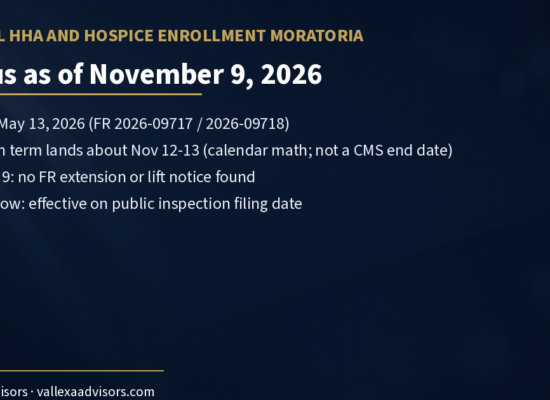
On May 13, 2026, CMS began a nationwide, six-month moratorium on new Medicare enrollments for home health agencies and hospices, with Federal Register notices following on May 15 (CMS memo QSO-26-11; American Hospital Association). By its terms the freeze runs to about November 13, 2026, unless CMS extends it in another six-month period (Polsinelli). Home Health Care News reported in August that many in the industry expect an extension this month (Home Health Care News, August 2026).
If you own an existing Medicare-certified agency, the home health enrollment moratorium changes two things at once. It freezes the supply of new competitors, which supports the value of your Medicare certification, and it makes the structure of any sale matter more than it did a year ago. At the same time, deal volume has cooled: Mertz Taggart counted 11 closed home-based care deals in the third quarter of 2026, down from 23 in the second quarter and 22 a year earlier, with sponsor-backed buyers behind 8 of the 11 (Mertz Taggart, Q3 2026 report, October 26, 2026). In the firm’s words, “Buyers have gotten more careful, and that’s not bad news for owners who run a clean shop.”
This article explains what the moratorium covers, what it does and does not do to the value of your certification, how sales still close, what buyers are asking in diligence, and how to prepare. We write it as the advisors who sit next to owners making this decision, so every claim is dated and sourced, and every valuation point is conditioned on facts we cannot see from here.
Key takeaways
- The moratorium froze new home health and hospice Medicare enrollments on May 13, 2026 and is scheduled to end about November 13, 2026 unless CMS extends it (CMS, 2026).
- Existing agencies keep billing, and sales that let the buyer step into your existing enrollment are generally still allowed (Polsinelli, 2026).
- Deals that would force a buyer to enroll as a new provider, including some sales inside the 36-month window, are blocked while the freeze lasts.
- Braff Group data reported in August 2026 shows certified home health deals on pace for 48 in 2026, up 41%, and hospice on pace for 44, up 57%.
- Any value effect from scarcity is a supporting factor. Payer mix, compliance history, referral relationships, staff retention, and leadership depth still set your price.
What is the home health enrollment moratorium?
The home health enrollment moratorium is a nationwide, six-month CMS suspension, effective May 13, 2026, of initial Medicare enrollment for new home health agencies and hospices. CMS announced it as part of the Vice President’s Anti-Fraud Task Force and said it would use the six months to intensify anti-fraud efforts in the sector (AHA, May 13, 2026).
The scope is broader than many owners first assumed. The CMS memo applies the freeze to every initial hospice and home health application not received by the Medicare contractor before May 13, and to new home health branches. It allows no exceptions for individual providers, and accreditation by a CMS-approved accrediting organization does not support deemed status during the freeze (CMS, QSO-26-11). Applications submitted during the moratorium are denied and must be resubmitted after it lifts.
There is precedent. CMS imposed a home health moratorium in 2013 in selected metro areas, and it was extended repeatedly until January 30, 2019 (Polsinelli, 2026). The 2026 action is nationwide, and CMS can renew it in six-month increments, so owners should plan for more than one outcome.
Who does the moratorium cover, and what is still allowed?
The moratorium blocks new Medicare enrollments and new locations, and it leaves existing, enrolled agencies largely free to operate, revalidate, and be sold through structures that do not require a new enrollment. The table below summarizes the guidance we reviewed as of November 2026.
| Activity | Status during the moratorium |
|---|---|
| New agency application received on or after May 13, 2026 | Denied; resubmit after the moratorium is lifted |
| Application received by the contractor before May 13, 2026 | Continues processing; later rejection or denial can fall under the moratorium |
| New home health branch or hospice practice location | Treated as an initial enrollment and barred |
| Change of information, revalidation, name or personnel updates | Allowed, as long as no new enrollment is triggered |
| Relocation within the same community | Allowed |
| Expansion within existing geographic service area, where state law permits | Allowed |
| Change of ownership that does not trigger new enrollment | Generally allowed |
| Ownership change that triggers new enrollment | Barred while the moratorium is in force |
Two groups feel it most. Founders hoping to open a new Medicare-certified agency cannot, for now. And buyers planning to enter a market by opening a branch cannot do that either, which pushes them toward acquiring something that already exists.
Does the moratorium make an existing Medicare-certified agency worth more?
It can support the value of an existing certification by limiting new competition and making acquisition the main route into a market, but we have not seen published transaction data that isolates a premium from the moratorium itself, so owners should treat it as one supporting factor among several.
The logic is straightforward. A buyer that wants a footprint in your county or state used to have two choices: build or buy. With new enrollments frozen, build is closed, at least until CMS lifts the freeze, and buy is the only option. The Braff Group, reporting first-half 2026 data on August 25, 2026, projected 134 annualized transactions across certified home health, hospice, private duty, and Medicaid, up 12.6% from 119 in 2025. It said dealmaking could rise in volume and valuation over the next 12 months (Home Health Care News).
The caution is just as important. Scarcity does not rescue an agency with weak documentation, concentrated referral sources, or an owner who personally runs every relationship. Mertz Taggart’s Q3 commentary says buyers “will pay for scale and clinical capability, and they’re willing to wait for the right asset” (Q3 2026). A frozen pipeline of new competitors raises the value of a good asset. It does not turn a marginal one into a good one.
For a sense of how buyers frame this, think in layers. The base layer is your trailing adjusted EBITDA, which our guide to SDE and adjusted EBITDA in a home health valuation covers in detail. The second layer is quality: payer mix, case mix, referral diversity, staff retention. The third layer, where the moratorium sits, is strategic: how much a buyer values your certification, your service area, and your team in a market it cannot enter another way. Ranges at every layer depend on payer mix, geographic footprint, staff retention, and referral relationships, and we cannot promise a specific multiple.
Can you still sell a home health agency during the moratorium?
Yes, you can sell during the moratorium, provided the transaction lets the buyer take over your existing Medicare enrollment instead of applying for a new one. The structure decides whether a deal proceeds, and two deals that look identical at the letter of intent stage can land on opposite sides of that line (Soriaga CPA, 2026).
The pivot point is the 36-month rule. Under 42 CFR 424.550, a home health agency that undergoes a change in majority ownership within 36 months of its initial enrollment or its last change in majority ownership generally must re-enroll as a new provider, subject to exceptions (eCFR). During the moratorium, a deal that triggers that re-enrollment cannot get through. The table is an illustration of the general pattern, not legal advice.
| Deal structure | General moratorium effect | What it means for you |
|---|---|---|
| Sale outside the 36-month window; buyer assumes your existing enrollment (CHOW) | Generally allowed | Standard path; the buyer inherits your Medicare liabilities |
| Sale within 36 months of initial enrollment or last majority ownership change | May require new enrollment, which the moratorium blocks, unless an exception applies | Confirm your dates and any exception with counsel before going to market |
| Indirect ownership transaction, such as an equity sale at a parent level | Generally does not trigger new enrollment | Often used by sponsor-backed buyers; ownership disclosure still applies |
| Buyer plans to add a new branch after closing | Barred during the moratorium | Buyer must plan growth within your existing service area |
| Acquisition of an agency with an application pending since before May 13, 2026 | Application continues processing | Treat as a separate diligence item; timing and status matter |
Our guide to the home health 36-month rule walks through the ownership-change mechanics, the four exceptions and how buyers price an agency still inside the window. The short version for this moment is to know your enrollment history before you speak to a buyer, because it determines which buyers can legally close with you.
What are buyers asking in diligence now?
Buyers are asking for more proof, earlier, on compliance history, documentation quality, ownership structure, and leadership depth, and they are using the proposed 2027 enforcement changes as a reason to dig deeper.
Mertz Taggart reports that deals are taking longer to close and that buyers are scrutinizing compliance history, documentation, and leadership depth more closely (Q3 2026). Three themes come up repeatedly in the diligence requests we see from sponsor-backed buyers:
- Recoupment tail. The CY 2027 final rule expands the grounds on which a revocation can take a retroactive effective date. For some grounds, including noncompliance with the 36-month change-in-majority-ownership rules, the date is when CMS or its contractor determines the enrollment should be revoked, not when noncompliance began (91 FR 72114). Buyers reconcile open cost reports, additional documentation requests, and settlements to size that tail. Ask counsel which ground and which date apply.
- Owner-level screening. The proposal would extend denial and revocation grounds to a provider’s owners and managing employees, so buyers now run exclusion checks on everyone on your enrollment record.
- Ownership transparency. CMS plans to require private equity and REIT ownership disclosure on Forms CMS-855B, CMS-855S, and CMS-20134, through information collection requests rather than notice-and-comment rulemaking (Holland and Knight). Buyers want a clean ownership map before they sign.
None of that is new in spirit. What changed in 2026 is the timing. Buyers raise these questions in the first call, not at the confirmatory stage, and an agency that answers them cleanly shortens the process. Our guide to what buyers check in a home health agency covers the diligence questions we see most often.
See where your agency stands before a buyer does
Start with the free ValueMyBusiness valuation calculator for a quick range, or ask for a confidential conversation with our team about your enrollment history, structure, and timing. Everything stays confidential, and our fees are 100% success-based.
What does the CY 2027 home health rule add to the picture?
The CY 2027 home health rule pairs a modest payment increase with a temporary cut, plus enrollment enforcement provisions that sit alongside the moratorium. As of November 2, 2026, the final rule was still under OMB review (CHAP Compliance Monitor, October 30, 2026). CMS published the final rule in the Federal Register on November 9, 2026, as FR Doc 2026-22750 (CMS-1844-F), 91 FR 72022 (Federal Register).
CMS estimated in the July 2026 proposed rule that aggregate Medicare home health payments would rise about 2.4%, or $420 million, from a 2.1% market basket update net of productivity plus a 0.3% outlier-related increase (Holland and Knight). The November 9, 2026 final rule keeps the 2.4% headline and revises the dollar estimate to about $415 million (91 FR 72151). Both the proposal and the final pair that update with a temporary negative 3% adjustment that CMS estimates would begin to recoup about $500 million of an estimated $4.9 billion in prior temporary-adjustment dollars (91 FR 72034, 72038). For context, the rule proposed in 2025 for CY 2026 floated a 6.4% cut and was finalized at a 1.3% cut, which is why some analysts believe CMS has “battered home health enough” and that payment predictability may improve (Home Health Care News).
On enrollment, the final rule finalizes new grounds to deny or revoke Medicare enrollment when an HHA, hospice, or DMEPOS supplier fails to comply with the existing change-in-majority-ownership provisions at 42 CFR 424.550(b) or 424.551 (new 42 CFR 424.530(a)(22) and 424.535(a)(25), 91 FR 72115). The 36-month rule itself is not new. The final also finalizes an excessive-concentration revocation ground at 42 CFR 424.535(a)(24) (91 FR 72105). Ask counsel how those grounds interact with any ownership path under discussion. This post is educational only.
| Item | Figure | Source |
|---|---|---|
| Proposed CY 2027 aggregate payment change | Up 2.4%, about $420 million | Holland and Knight, July 2026 |
| Temporary behavioral adjustment | Negative 3%, recouping about $500 million of an estimated $4.9 billion | Holland and Knight, July 2026 |
| CY 2026 rule, proposed vs final | Proposed 6.4% cut; finalized 1.3% cut | Home Health Care News, August 2026 |
| MedPAC recommendation for 2027 base rate | 7% reduction | Soriaga CPA, 2026 |
| Freestanding HHA Medicare fee-for-service margin | 20.2% (2023); 21.2% (2024); 19% projected (2026) | Soriaga CPA, citing MedPAC |
| Hospice FY 2027 payment update | 2.3%, effective October 1, 2026 | Mertz Taggart, Q3 2026 |
| Public comments on CMS-1844-P | 657 submissions; comment period closed August 31, 2026 | Soriaga CPA; Holland and Knight |
For an owner, the practical reading is that the reimbursement outlook looks steadier than it did a year ago, while the compliance outlook looks stricter. Mertz Taggart notes that positive 2027 rate updates give buyers a clearer reimbursement outlook. A steadier rate environment helps buyers underwrite, and a stricter enforcement environment is why they ask more questions.
How do you prepare your agency to sell while the moratorium is in force?
Prepare by fixing what buyers will test first: enrollment history, recoupment exposure, owner screening, ownership mapping, documentation, and leadership depth. The seven steps below follow the order in which diligence usually unfolds.
- Confirm your enrollment history and 36-month position. Pull your initial enrollment date, every change in majority ownership since, and the dates of each. Buyers and their counsel check this first, because it decides whether a deal can proceed as a change of ownership or would force new enrollment.
- Reconcile open cost reports, ADRs, and settlements. List every open cost report year, additional documentation request, and pending settlement, and estimate any recoupment exposure. A change of ownership does not erase your Medicare liabilities, so buyers will price the tail they inherit.
- Run exclusion checks on every owner and managing employee. Screen all owners, officers, directors, and managing employees against the OIG exclusion list and SAM.gov, and keep dated records. The CY 2027 proposal would extend denial and revocation grounds to owners and managing employees, so buyers are already asking.
- Map your full ownership structure. Document every direct and indirect owner, including any private equity or REIT interest, in a clean ownership chart that matches your CMS-855 filings. CMS has said it plans to require private equity and REIT ownership disclosure on enrollment forms.
- Audit documentation on a sample of charts. Review a sample of recent episodes for face-to-face encounter documentation, plans of care, OASIS accuracy, and certifications. Fix patterns before diligence finds them, because clean documentation is what buyers mean by a clean shop.
- Build leadership depth beyond the owner. Name the administrator, director of nursing, and billing lead who can run the agency through a transition. Mertz Taggart reports buyers are scrutinizing leadership depth more closely in diligence this year.
- Get a structure-aware valuation and set a decision date. Ask an advisor to value the agency on your trailing numbers and show how deal structure affects who can buy. Then set a decision date that accounts for the November 13 expiration and the possibility of an extension.
Most owners come to us 6 to 9 months later than they should, and these steps are why. Several of them, particularly reconciling cost reports and mapping ownership, take weeks and need your accountant and counsel. Starting now leaves time to fix issues instead of explaining them. Our seven steps to selling describes the full sequence from preparation to close.
Should you sell now or wait to see whether the moratorium is extended?
A better time to sell depends on your own financials, compliance record, and structure, not on a calendar date, so the best approach is to get a structure-aware valuation now and let the numbers tell you whether waiting adds anything.
The outcomes are uncertain, and each carries a different consideration for owners. The table lays them out without assuming which one CMS will choose.
| Scenario | What it likely means | Owner consideration |
|---|---|---|
| CMS extends the moratorium for another six months | New enrollments stay frozen; acquisition remains the main route into a market | Scarcity continues to support interest, but diligence stays tight; do not assume additional premium |
| CMS lets the moratorium lapse | New applications resume, though new entrants still need to clear enrollment and survey | The scarcity argument weakens over time; clean, well-documented agencies remain attractive |
| CMS lifts it and tightens enrollment screening | New entry stays harder than before the freeze | Existing certifications keep some strategic value; structure and compliance matter more |
| Final CY 2027 rule changes the rate or enforcement picture | Buyers re-underwrite reimbursement and risk | Be ready to update your numbers and answer new compliance questions |
Three facts argue against waiting by default. Buyers are paying for clean agencies today, with The Braff Group’s annualized first-half figures putting certified home health deals on pace to rise 41% and hospice 57% in 2026 (Home Health Care News). An extension is possible, and the 2013 moratorium lasted until January 30, 2019. And the proposed enforcement changes reward agencies that are already prepared. One fact argues for patience: if your trailing numbers are in a dip or your documentation needs repair, a few quarters of work can raise what a buyer will pay more than any calendar event.
If you want a view on your own situation, start with our home health agency valuation guide, read how buyers frame when to sell a home health agency, or look at our home health practice. Everything is confidential, and nothing obliges you to sell.
Hospice owners face the same enrollment freeze, with their own rate backdrop: a 2.3% FY 2027 payment update in the final hospice rule. Our post on who buys hospice agencies covers the buyer universe, and our hospice practice page covers sale preparation.
Home health enrollment moratorium FAQ
It is a nationwide, six-month CMS freeze, effective May 13, 2026, on initial Medicare enrollment applications for new home health agencies and hospices, including new home health branches and hospice locations. Agencies already enrolled keep billing, and applications received before May 13 continue processing.
The moratorium runs six months from May 13, 2026, which is about November 13, 2026. CMS can extend it in additional six-month periods or lift it, and any change is announced in the Federal Register. As of November 2, 2026, we have not seen an extension notice.
No. Sales that let the buyer take over your existing Medicare enrollment, such as a change of ownership outside the 36-month window or an indirect ownership transaction, are generally allowed. Deals that would force a buyer to enroll as a new provider are blocked while the moratorium is in force.
It can support value, because competitors cannot easily open new Medicare-certified agencies, but we have not seen published transaction data that isolates a premium. Price still depends on payer mix, compliance history, referral relationships, staff retention, and leadership depth, so treat any premium as a supporting factor, not a guarantee.
Yes. The same CMS action covers new hospice enrollments and new hospice practice locations, with separate Federal Register notices for home health agencies and hospices published May 15, 2026. Existing Medicare-certified hospices keep operating and must continue to meet revalidation and change-of-information requirements.
The 36-month rule generally requires a home health agency that changes majority ownership within 36 months of initial enrollment or its last majority ownership change to re-enroll as a new provider, unless an exception applies (42 CFR 424.550). During the moratorium, a deal that triggers that re-enrollment is blocked.
CMS proposed a 2.4% aggregate payment increase, about $420 million, and finalized about $415 million at the same 2.4% headline (91 FR 72151). The temporary negative 3% adjustment remains, with CMS estimating about $500 million of an estimated $4.9 billion in prior temporary-adjustment dollars for CY 2027 (91 FR 72034, 72038). The final rule also adds denial and revocation grounds for noncompliance with the existing 36-month change-in-majority-ownership rules at 42 CFR 424.550(b) (new 42 CFR 424.530(a)(22) and 424.535(a)(25), finalized at 91 FR 72115). The 36-month rule itself is not new. CMS published the final rule on November 9, 2026, as FR Doc 2026-22750 (91 FR 72022).
Not by default. A preferred time to sell depends on your trailing financials, compliance record, and structure, not on a calendar date. Buyers are paying for clean agencies now, and an extension is possible, so we suggest getting a structure-aware valuation first and then deciding whether waiting adds anything.
Generally no. CMS treats a new home health branch or hospice practice location as an initial enrollment, so it is barred during the moratorium. Expansion through your existing geographic service area, where state law permits, and relocations within the same community remain allowed under the CMS guidance we reviewed.
Start a confidential conversation about your agency
Tell us about your agency and your timing. We will tell you what a buyer would see, how your enrollment history affects the structure, and whether now is a sensible time to go to market. There is no cost unless we close a transaction. If you would like our pre-sale readiness checklist, ask for it in your message and we will send it.
Related reading
- Home health agency valuation in 2026
- The home health 36-month rule and your sale
- What buyers look for in a home health agency
- When to sell a home health agency
- Who buys hospice agencies
- ValueMyBusiness.com: free valuation tools
- ExitStrategies.com: exit planning
- Exits.ai: confidential buyer mandates
Sources
- CMS, memo QSO-26-11, home health and hospice enrollment moratoria (May 2026)
- American Hospital Association, CMS announces 6-month enrollment moratorium (May 13, 2026)
- Polsinelli, moratoria FAQ analysis (2026)
- Mertz Taggart, Q3 2026 Home-Based Care M&A Report (October 26, 2026)
- Home Health Care News, home health M&A activity (August 2026)
- Holland and Knight, CY 2027 home health proposed rule (July 2026)
- Soriaga CPA, home health enrollment moratorium 2026
- eCFR, 42 CFR 424.550
- CHAP Compliance Monitor (October 30, 2026)
About the author
Jason Atty is the founder of Vallexa Advisors, a healthcare-only M&A advisory firm serving owners of home health, hospice, home care, and behavioral health agencies. Vallexa runs confidential, NDA-gated sale processes with a nationwide buyer network and charges 100% success-based fees.
Educational only. Not legal, financial, or tax advice. Healthcare M&A outcomes depend on specific facts, payer mix, market conditions, and regulatory context. Speak with qualified counsel before acting on anything in this document.