The home health 36-month rule decides whether a buyer can take over your Medicare provider agreement or has to start from scratch. Under 42 CFR 424.550(b), if more than half of a home health agency changes hands within 36 months of its initial Medicare enrollment, or within 36 months of its last change in majority ownership, the provider agreement and billing privileges do not transfer. The buyer must enroll as a brand new agency and pass a new state survey or accreditation. With a nationwide enrollment moratorium on new home health agencies in place since May 13, 2026, a sale that triggers the rule cannot close on the existing Medicare number at all.
This guide explains how the rule works, how many agencies it touches today, the four exceptions written into the regulation, and how buyers price an agency that is still inside the window. It is written for owners of Medicare-certified home health agencies who bought, opened or restructured their agency in the last three years and are thinking about a sale.
Key takeaways
- The rule is triggered by a change in majority ownership: one person or company acquiring more than 50% direct ownership, counted cumulatively across every sale, stock transfer, merger and consolidation inside the 36-month period.
- It applies to asset sales and stock sales alike. Changing the deal structure does not get around it.
- Of the 12,409 home health agencies in CMS’s current Care Compare file, 1,315 (10.6%) have a Medicare certification date later than October 27, 2023, so they are still inside 36 months of initial certification today.
- The CMS moratorium notice says plainly that a home health agency going through a non-exempt change in majority ownership counts as a new enrollment, so the moratorium blocks it.
- Four exceptions exist: two consecutive years of full cost reports, an internal corporate restructuring, a change in business structure with the same owners, and the death of an individual owner.
What the 36-month rule says
The regulation sits in 42 CFR 424.550(b)(1). In plain terms, if a home health agency has a change in majority ownership by sale within 36 months after its initial Medicare enrollment, or within 36 months after its most recent change in majority ownership, the provider agreement and Medicare billing privileges do not convey to the new owner. The new owner must instead do two things: enroll in Medicare as a new, initial home health agency, and obtain a state survey or accreditation from an approved accrediting organization.
The definition that matters is in 42 CFR 424.502. A change in majority ownership happens when an individual or organization acquires more than a 50 percent direct ownership interest during the 36-month period. The definition expressly includes majority ownership reached through the cumulative effect of asset sales, stock transfers, consolidations or mergers inside that period. Three points follow from that wording:
- It is about direct ownership. The test looks at who directly holds the agency’s equity, so a buyer cannot assume that an extra holding company layer changes the answer. Ask counsel to map the direct owner before and after closing.
- Small sales add up. Selling 30% this year and 25% next year to the same buyer crosses 50% inside the window, and the second closing triggers the rule.
- The clock restarts. Every change in majority ownership starts a new 36-month period. An agency bought two years ago is inside the window again, even if it was first certified in 2009.
Why CMS wrote the rule
CMS explained the history in its May 15, 2026 home health moratorium notice. In the mid-2000s, CMS found that brokers were enrolling home health agencies after the survey or accreditation, then quickly selling them. The buyer could start billing Medicare without its own operation ever being surveyed. CMS added the 36-month rule in 2009 to stop that pattern. Buyers who know this history read a young agency the way CMS does: the license may be clean, but the operation behind it has not been tested for long.
How many agencies are inside the window right now
CMS publishes the certification date for every Medicare-certified home health agency in the Home Health Care Agencies dataset, the same data behind Care Compare. We pulled the full file (12,409 agencies, CMS release modified September 21, 2026) and counted agencies whose certification date falls after October 27, 2023, which means fewer than 36 months have passed.
| Measure (CMS Home Health Care Agencies file) | Count |
|---|---|
| Medicare-certified home health agencies in the file | 12,409 |
| Certification date after October 27, 2023 (inside 36 months today) | 1,315 (10.6%) |
| Of those, located in California | 724 (55%) |
| Of those, with no quality of patient care star rating yet | 994 (76%) |
| Agencies certified in calendar 2023 / 2024 / 2025 | 603 / 562 / 641 |
Two cautions on these numbers. First, they measure only the initial certification clock. The public file does not show changes in majority ownership, so the real number of agencies inside a 36-month window is higher. An older agency that sold a majority stake in 2024 is inside the window again and will not show up here. Second, the certification date is the closest public proxy for the initial enrollment effective date. It is a good starting point, not a legal conclusion, and your enrollment record in PECOS is the document that counts.
The star rating line matters for pricing too. Three out of four agencies inside the window have no quality of patient care star rating yet, usually because they do not have enough patient data. A buyer looking at a young agency often sees a blank quality profile and a 36-month problem at the same time.
What happens when a sale trips the rule
If a sale triggers the rule and no exception applies, the buyer does not inherit your provider agreement. The moratorium notice describes it directly: the agency’s current enrollment and provider agreement are terminated, and the new enrollment is an initial enrollment “no less than if the HHA had never enrolled in Medicare before.”
In normal times, that means:
- A new Medicare enrollment. The buyer files as a new home health agency, goes through the high-risk screening that applies to home health (site visit and fingerprinting of 5% or greater owners), and waits for approval.
- A new survey or accreditation. The agency must be surveyed again before it can bill Medicare under the new owner.
- A billing gap. Medicare revenue stops under the old number and restarts only once the new enrollment and survey are complete. For an agency where Medicare is most of revenue, that gap can wipe out the business case.
For a buyer, an agency that cannot transfer its provider agreement is not much more than a team, a referral base and a state license that may or may not transfer. That is why the rule shows up as a price question and not just a legal footnote.
The moratorium makes the rule a hard stop
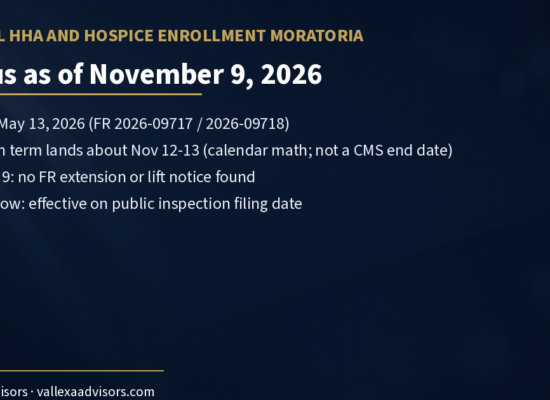
On May 13, 2026, CMS imposed a six-month nationwide moratorium on Medicare enrollment of new home health agencies, announced in 91 FR 27954. Under 42 CFR 424.570, a moratorium lasts six months and CMS can extend it in six-month increments.
Most changes of ownership are outside a moratorium. The notice lists the exception: changes in ownership are not covered, except changes in ownership of home health agencies, hospices and certain medical supply companies that would require an initial enrollment. The notice then spells out the result for home health: the moratorium “would prohibit an HHA undergoing a non-exempt CIMO from reenrolling in Medicare.”
So while the moratorium is in force, a sale that trips the 36-month rule has no path to a Medicare-billing agency under the new owner. The initial six months run to November 13, 2026. Our guide on whether CMS extends the enrollment moratorium covers what CMS weighs and what each outcome means for sellers. If the moratorium is extended, every inside-window agency stays unsellable as a going concern on its current number for at least another six months.
The four exceptions in the regulation
Section 424.550(b)(2) lists four situations where the rule does not apply. Each one needs documents, not just a claim.
1. Two consecutive years of full cost reports
If the agency has submitted two consecutive years of full cost reports since its initial enrollment or its last change in majority ownership, whichever is later, the rule does not apply. The regulation is explicit that low utilization or no utilization cost reports do not count. This is the exception owners ask about most, and the one most often misread. A young agency with a small census that filed low utilization reports has not met it, even if two cost reporting years have passed.
What to have ready: both cost reports, proof of submission and acceptance from your Medicare Administrative Contractor, and a short note from your cost report preparer confirming they were full reports.
2. Internal corporate restructuring
A merger or consolidation inside the agency’s parent company is exempt. This covers groups reorganizing their own entities. It does not cover a sale to an outside buyer described as a restructuring.
3. A change in business structure with the same owners
Converting from a corporation to an LLC, or from a partnership to an LLC, is exempt as long as the owners stay the same. Owners sometimes do this before a sale for tax reasons. Keep the ownership identical through the conversion, and do not combine it with a new investor.
4. Death of an individual owner
If an individual owner dies, the resulting transfer is exempt. This matters for estate planning in family-owned agencies, and it is one more reason to keep the ownership ledger current.
How buyers price an agency inside the window
Buyers handle the 36-month rule in a few predictable ways. Knowing them helps you decide whether to sell now or wait.
They wait. If the window closes in a few months, many buyers will sign a letter of intent now and set the closing for after the 36-month date, with interim covenants on operations. The seller keeps running the agency and carries the risk until closing. This is the cleanest route if the moratorium is lifted, the window is short and the agency is stable.
They buy a minority stake now and the rest later. A buyer can acquire 50% or less now, with a right to buy the balance after the window ends. Because the regulation counts cumulative transfers inside the 36-month period, the second purchase has to close after the period ends. Healthcare counsel should draft this, because a poorly timed option or control right can create the problem it was meant to avoid.
They price the agency as a license. If the rule would force a new enrollment, a buyer values the agency on what transfers: state licensure, accreditation work, staff and referral relationships. That number is usually far below a going-concern value based on earnings. Our guide to home health agency valuation explains how earnings-based multiples work for agencies that do transfer cleanly, which is the comparison an inside-window owner should keep in mind.
They walk. Some private equity platforms and regional operators will not underwrite an agency inside the window at all while the moratorium is in place. That narrows the buyer pool, and a narrow pool usually means a lower price and weaker terms.
The opposite also holds. An agency clearly past its 36-month date, with no change in majority ownership since, removes a whole category of risk. Sellers who can prove that early in the process tend to get better terms. Several agencies we currently represent are marketed on exactly that point, including a Missouri Medicare-certified home health agency in southwest Missouri, an Ohio home health agency with skilled Medicaid and a San Diego County home health agency marketed as 36-month exempt.
A seller’s checklist before you go to market
Buyers will ask about the 36-month position in the first call. Have the answer and the documents ready before you start:
- Find your certification date. Look up your agency’s CMS Certification Number in the CMS Home Health Care Agencies data and confirm the date against your own enrollment approval letter.
- Build a complete ownership history. List every transfer of equity since initial enrollment, with dates and percentages, including small transfers between partners. Add them up the way the regulation does: cumulatively, inside each 36-month period.
- Match it to your Medicare enrollment record. Your CMS-855A filings in PECOS should show the same owners. Gaps between what PECOS shows and what your operating agreement shows are a common diligence finding and slow deals down.
- Collect your cost reports. If you plan to rely on the cost report exception, confirm both years were full reports and get your preparer to say so in writing.
- Check state rules separately. State licensure has its own change of ownership process and timeline, and some states have their own moratoria. Meeting the federal rule does not settle the state side.
- Disclose it early. Put the 36-month position in your confidential information memorandum. Buyers trust a seller who raises it first, and a surprise in diligence is when retrades start.
Our article on what buyers check in a home health agency covers the rest of the diligence list, from star ratings to payer mix. For the broader sale process, the home health agency sale guide walks through how Vallexa prepares and markets agencies.
A note on hospices
The same regulation has applied to hospices since January 1, 2024, and the current hospice moratorium creates the same hard stop. The mechanics, exceptions and buyer reactions are similar, but hospice buyers also weigh aggregate cap exposure and quality reporting that do not apply to home health. If you own both, treat each agency as its own analysis.
Frequently asked questions
It is a Medicare enrollment rule in 42 CFR 424.550(b). If a home health agency has a change in majority ownership within 36 months of its initial Medicare enrollment, or within 36 months of its last change in majority ownership, the provider agreement and billing privileges do not transfer to the new owner. The new owner must enroll as a new agency and obtain a new state survey or accreditation, unless one of four exceptions applies.
Both. The regulation covers changes in majority ownership by sale, including asset sales, stock transfers, mergers and consolidations. A buyer acquiring more than 50% direct ownership inside the 36-month period triggers it, and smaller transfers to the same buyer are added together.
Usually yes, if the sale does not trigger the 36-month rule. Changes of ownership are generally outside the moratorium. The exception is a home health change of ownership that requires an initial enrollment, which is exactly what a sale inside the 36-month window requires. CMS says the moratorium prohibits that re-enrollment while it is in effect.
There are four: the agency has submitted two consecutive years of full cost reports since initial enrollment or its last change in majority ownership (low or no utilization reports do not count); the parent company is going through an internal restructuring such as a merger or consolidation; the owners are changing the business structure while staying the same people; or an individual owner dies.
Start with the certification date for your CMS Certification Number in the CMS Home Health Care Agencies data on data.cms.gov and confirm it against your enrollment approval letter. Then review every ownership change since then, because each change in majority ownership starts a new 36-month period. Your CMS-855A enrollment record in PECOS is the document that controls.
Talk to Vallexa before you sign a letter of intent
Vallexa Advisors works with home health agency owners on timing, structure and buyer selection, including agencies close to their 36-month date. We work on a success fee basis and keep every conversation confidential. If you want to know where your agency stands, contact Vallexa for a confidential review.
This article is general information, not legal advice. Have healthcare counsel review your ownership history and deal structure before you sign.