On January 1, 2027, California’s minimum wage goes to $17.40 an hour and Washington’s goes to $17.73. Both numbers are above what the typical home care aide in the United States earned in May 2025: a median of $17.21 an hour, according to the Bureau of Labor Statistics Occupational Employment and Wage Statistics program. For an owner of a non-medical home care agency, that is not a payroll footnote. It is a change to the single biggest line in your P&L, and it lands at the start of the year in which many owners plan to go to market.
Buyers already know this. When a buyer looks at a home care agency in an indexed minimum wage state, the first question is no longer only “what did you earn last year?” It is “what will you earn after January, and who pays for the raise?” This guide explains how the 2027 increases work, how buyers turn a wage floor into a price, and what you can do before January 1 so the answer helps you.
Key takeaways
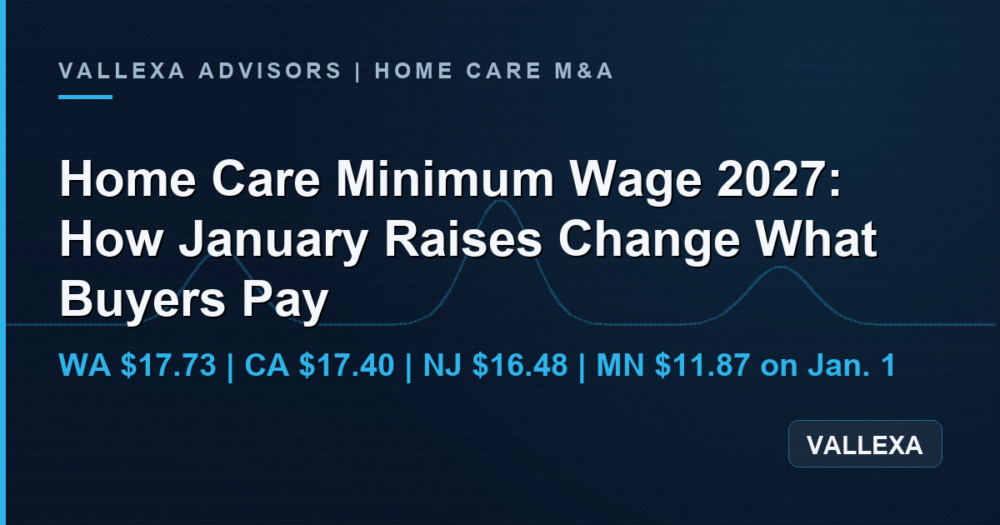
- Four state labor agencies have already set their 2027 floors: Washington $17.73, California $17.40, New Jersey $16.48 and Minnesota $11.87, all effective January 1, 2027.
- The typical aide is close to the line. The national median wage for home health and personal care aides was $17.21 an hour in May 2025 (BLS OEWS), so in the highest-floor states the new minimum is above the old national median.
- Buyers price the gap, not the headline. They compare your current wage scale to the new floor, add the compression raises above it, and ask how much of the cost you can pass to private-pay clients and Medicaid.
- Medicaid is the hard part. A state minimum wage increase does not raise a Medicaid personal care rate by itself. Unless your state adjusts the rate, the raise comes out of margin on those hours.
- Owners who act before January keep control of the story: a current wage scale, client rate notices already sent and a 2027 budget that already includes the raise.
What changes on January 1, 2027
Several states index their minimum wage to inflation and announce the next year’s rate in late summer or early fall. The four below are confirmed by each state’s own labor agency.
| State | 2026 rate | 2027 rate (Jan. 1) | Change | Primary source |
|---|---|---|---|---|
| Washington | $17.13 | $17.73 | +$0.60 | Washington L&I |
| California | not stated in release | $17.40 | inflation adjustment | California DIR release 2026-66 |
| New Jersey (most employers) | $15.92 | $16.48 | +$0.56 | NJ Department of Labor, Sept. 29, 2026 |
| Minnesota | $11.41 | $11.87 | +3.99% | Minnesota DLI, Aug. 19, 2026 |
A few details matter for home care operators:
- New Jersey has a second tier. Seasonal employers and small employers with fewer than six employees move to $16.25, up from $15.23, according to the same NJ release. A small agency should confirm which rate applies to it.
- California’s change also moves the exempt salary line. The DIR release sets the 2027 minimum salary for exempt employees at $72,384 a year, which is twice the new hourly rate for a full-time year. Office managers and schedulers paid on salary need to clear it or be reclassified.
- Cities can be higher. Some cities set their own minimums above the state floor. If you run caregivers in a city with its own ordinance, the city rate is the one that matters, and buyers will check it.
- Your state may not be on this list. Other states announce on their own calendars. Check your state labor department before you budget, not a third-party summary.
Why a wage floor hits home care harder than most industries
In most service businesses, the minimum wage sets the pay of a few entry roles. In non-medical home care it often sets the pay of the core workforce. The service you sell is caregiver hours, and caregiver pay is the biggest cost behind each hour.
The national numbers show how close the workforce sits to these floors. BLS reports that 4,305,810 people were employed as home health and personal care aides in May 2025, with a median hourly wage of $17.21, a mean of $17.36 and a median annual wage of $35,800 (BLS OEWS, SOC 31-1120). The industry that employs much of that workforce keeps growing: BLS counts 3,000,900 jobs in services for the elderly and persons with disabilities in August 2026, a preliminary figure (BLS Current Employment Statistics, series CES6562412001).
Those are national medians. Pay in Washington or California is generally higher than the national figure, so not every caregiver there earns under the new floor. But the closer your starting wage sits to the state minimum, the more of your hours a January increase touches.
There is a second effect owners tend to underestimate. When the floor rises, the caregivers who were paid above it expect to stay above it. A caregiver hired at $17.75 because of two years of experience will not want the same rate as a new hire who now starts at $17.73. That is wage compression, and buyers model it. They do not stop at the hours that fall below the new minimum. They ask what it will cost to keep your pay ladder intact.
How buyers turn a wage increase into a price
Buyers of home care agencies value the business on its earnings: seller’s discretionary earnings (SDE) for most owner-operated agencies, adjusted EBITDA for larger platforms. A wage increase that is not recovered through pricing comes straight off that number, and the buyer then applies a multiple to what is left.
Here is a simple illustration. The figures are hypothetical and chosen for easy arithmetic. They are not a quote for any real agency or a statement of market multiples.
| Item | Illustrative agency |
|---|---|
| Caregiver hours delivered per year | 100,000 |
| Average raise needed to meet the new floor and keep the pay ladder | $0.60 per hour |
| Added wages per year | $60,000 |
| Employer payroll taxes and wage-based costs (assumed 10%) | $6,000 |
| Total added labor cost | $66,000 |
| Share recovered through rate increases | 0% |
| Earnings reduction | $66,000 |
If a buyer applies a 4x multiple to earnings in this example, the unrecovered raise reduces the price by $264,000. If the agency recovers the full cost through rate increases, the price impact can be close to zero. Most real agencies land in between, and the buyer’s job in diligence is to find out where.
Notice what the buyer is really pricing. It is not the minimum wage itself. Every agency in the state faces the same floor. The buyer is pricing your ability to pass the cost through, and that depends on your payer mix, your contracts and your record of raising rates without losing clients.
Private pay vs. Medicaid: who pays for the raise
Private pay clients
Private-pay agencies set their own hourly rates, so in principle they can recover a wage increase. In practice, buyers look for evidence that you already have:
- A rate increase history. Did you raise rates in January 2025 and January 2026, and how many clients left after each increase?
- Client agreements that allow it. Do your service agreements let you change rates with notice, and how much notice do they require?
- Notices already sent. An agency that mailed its 2027 rate letters in October and kept its clients has turned a risk into a fact. An agency that plans to “look at it in the spring” has handed the buyer an assumption to discount.
Long-term care insurance clients and third-party payers can be harder. Some policies reimburse a fixed daily or hourly amount, and the client pays the difference. A rate increase that pushes the client’s share up can cost you the case. Buyers will ask how many of your hours fall into that group.
Medicaid and other government payers
Medicaid personal care and home and community-based services rates are set by each state, not by the agency. A state minimum wage increase does not change your Medicaid rate unless the state acts. Some states adjust rates with wage changes; many adjust on their own budget cycle, which may not line up with January 1.
That means a Medicaid-heavy agency in a rising-floor state can see its wage cost go up in January while its revenue per hour stays flat. Buyers know this, and they look for the state’s rate notices and the agency’s realized rate per hour by payer. If your Medicaid rate has not moved in several years, expect a buyer to assume the gap keeps growing.
There is also a policy layer on top. The federal Medicaid Access Rule’s 80/20 provision ties a share of certain home care payments to direct care worker pay. We covered how buyers already price it in our guide to the Medicaid 80/20 rule. A rising state floor and the 80/20 provision push in the same direction: more of each Medicaid dollar goes to wages. That is good for caregivers and it narrows the margin a buyer can count on.
Payer mix shapes the whole answer. Our article on private pay vs. Medicaid and home care value explains why buyers often pay differently for those two revenue streams.
VA and other contracted payers
Agencies that serve veterans through the VA or work under managed care contracts have a third situation: the rate is set by contract. Buyers will read those contracts for rate escalators and renewal dates. A contract that reprices annually is worth more in a rising-wage year than one locked until 2028.
Overtime makes the math bigger
Minimum wage and overtime work together. A caregiver who works live-in shifts or long weekly schedules may earn overtime, and overtime is paid at one and a half times the regular rate. Raise the regular rate and every overtime hour costs more too.
Buyers will ask how many of your hours are overtime hours, and whether your scheduling keeps them under control. If your agency depends on a few caregivers working very long weeks, the 2027 increase lands on those hours at time and a half. We explained the federal overtime rules for home care in our guide to the overtime rule and home care value.
What a buyer will ask for in diligence
Expect a buyer of a home care agency in an indexed-wage state to request most of the following:
- A current caregiver wage scale showing every pay rate, how many caregivers sit at each rate, and how many hours each rate covered in the last twelve months.
- A 2027 wage plan showing the new floor, the compression raises you plan above it, and the total added cost.
- Rate history by payer for the last two or three years: private pay, long-term care insurance, Medicaid, VA and managed care, with realized revenue per hour for each.
- Client rate notices sent for 2027, and client retention after the last two increases.
- Medicaid rate notices from your state agency and any announced changes for the coming state fiscal year.
- Overtime hours as a share of total hours, by month.
- Payroll tax and workers’ compensation costs that rise with wages.
- City-level exposure: which caregivers work in cities with their own minimum wage.
None of this is unusual. What changes the price is whether you hand it over clean and complete or whether the buyer has to build it from raw payroll files. The second path costs you time, and it usually ends in a more cautious number.
Five moves to make before January 1
- Build your 2027 wage scale now. Put every caregiver rate on one page, raise the bottom to the new floor, and decide how far up the ladder you will carry the increase. Price it in hours, not headcount.
- Send private-pay rate notices on time. Check how much notice your client agreements require and send letters early enough to meet it. Track every client who leaves or reduces hours afterward. That retention number is one of the most persuasive facts you can show a buyer.
- Document your Medicaid position. Pull your state’s current personal care rates and any rate notices for the next state fiscal year. If your margin on Medicaid hours turns negative after January, decide now whether to limit new Medicaid cases or change the mix.
- Review your contracts. Read every VA, managed care and facility contract for rate escalators and renewal dates. Ask for a rate review where a contract allows it.
- Restate your earnings forward. When you prepare for a sale, show trailing twelve-month SDE or EBITDA and a pro forma that already includes the 2027 wage cost and the rate increases you have actually put in place. A buyer is going to build that number anyway. It is better if yours is the first one on the table.
Our exit preparation guide has a longer checklist for the year before you go to market. For the valuation basics, see what a home care business is worth in 2026 and our home care valuation and selling guide.
Does a higher minimum wage make a home care agency worth less?
Not on its own. Every agency in the state faces the same floor, and buyers adjust for it across the whole market. What separates one agency from another is how well each one absorbs it.
An agency that already pays above the new floor, has raised private-pay rates without losing clients and holds contracts that reprice annually may barely notice January 1. In a buyer’s eyes, that agency has proven pricing power, and pricing power is one of the things buyers pay for.
An agency with most of its hours in a Medicaid program whose rate has not moved, a pay scale bunched at the old minimum and no rate letters sent will show a lower 2027 earnings line. The buyer will price that line, or ask for terms such as an earnout tied to 2027 results.
The difference between those two agencies is mostly work the owner can do in the next ten weeks.
What this means if you are selling now
If you are already talking to buyers, expect the 2027 wage floor to come up in the first serious conversation, not in late diligence. Have your wage scale and rate plan ready before the call.
If you are a year or more from a sale, the January 2027 increase is a chance to show a buyer something valuable: that your agency can absorb a cost increase and keep its margin. Two clean rate cycles with stable client retention can be worth more than a strong single year of revenue.
Vallexa currently lists non-medical home care opportunities, including a licensed in-home care agency in the Dallas-Fort Worth area and a home care agency in central Pennsylvania. If you want to understand how a buyer would view your agency after January 1, contact Vallexa Advisors for a confidential conversation.
Frequently asked questions
Effective January 1, 2027, state labor agencies have set the minimum wage at $17.73 an hour in Washington, $17.40 in California, $16.48 for most employers in New Jersey and $11.87 in Minnesota. Some cities set higher local minimums, so check your city as well as your state.
Buyers value home care agencies on earnings (SDE or adjusted EBITDA). A wage increase that the agency cannot recover through higher rates comes straight off earnings, and the buyer applies a multiple to what is left. The agency’s ability to pass the cost to private-pay clients, Medicaid and contracted payers decides how much value is lost, if any.
Not automatically. Medicaid personal care and home and community-based services rates are set by each state, often on a state budget cycle that does not line up with January 1. Unless your state adjusts the rate, a wage increase reduces the margin on Medicaid hours.
Close. The Bureau of Labor Statistics reports a national median wage of $17.21 an hour for home health and personal care aides in May 2025, with 4,305,810 people employed in the occupation. The 2027 minimums in California and Washington are above that national median, although pay in those states is generally higher than the national figure.
Prepare a current caregiver wage scale, a 2027 wage plan that includes compression raises, rate history and realized revenue per hour by payer, copies of 2027 client rate notices with retention results, Medicaid rate notices from your state, overtime hours by month, and a pro forma that already includes the 2027 wage cost.
Sources
- Washington State Department of Labor and Industries, Minimum wage: $17.73 an hour for most workers effective Jan. 1, 2027; $17.13 in 2026.
- California Department of Industrial Relations, News release 2026-66, Aug. 13, 2026: $17.40 an hour from Jan. 1, 2027; exempt salary threshold $72,384.
- New Jersey Department of Labor and Workforce Development, Press release, Sept. 29, 2026: $16.48 an hour for most employers (+$0.56); $16.25 for seasonal and small employers.
- Minnesota Department of Labor and Industry, News release, Aug. 19, 2026: $11.87 an hour, a 3.99% adjustment, effective Jan. 1, 2027.
- U.S. Bureau of Labor Statistics, Occupational Employment and Wage Statistics, May 2025, Home Health and Personal Care Aides (31-1120): employment 4,305,810; median hourly wage $17.21; mean hourly wage $17.36; median annual wage $35,800.
- U.S. Bureau of Labor Statistics, Current Employment Statistics, series CES6562412001, services for the elderly and persons with disabilities: 3,000.9 thousand jobs, August 2026 (preliminary).
This article is general information for business owners, not legal, tax or wage-and-hour advice. Confirm the rates and rules that apply to your agency with your state labor department and your employment counsel.