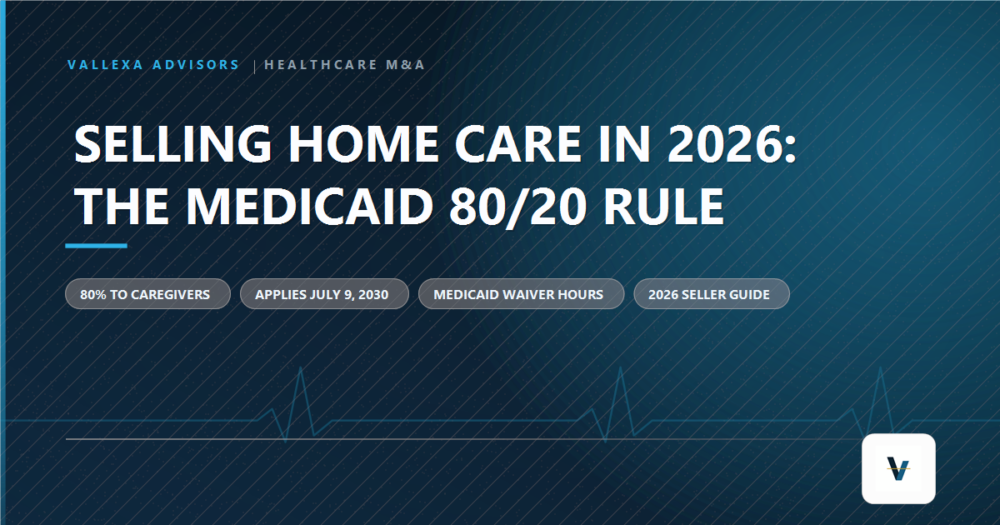
If your home care agency bills a Medicaid waiver program for personal care, homemaker, or home health aide hours, there is one ratio a buyer will compute before they ever discuss price: how many cents of every Medicaid dollar you pay out to the caregivers who deliver the hours. Federal regulation now sets a target for that ratio, 80 cents, and the date it applies falls squarely inside the hold period of anyone who buys your agency this year or next.
Most owners have heard the shorthand “the 80/20 rule.” Far fewer have read the regulation, worked out their own number, or thought about what it does to the price of their business. This guide covers what the rule actually says, the dates that matter, how a buyer turns it into an earnings adjustment, and what a seller can do in the next ninety days to control that conversation rather than react to it.
What does the Medicaid 80/20 rule actually require?
The rule comes from the “Ensuring Access to Medicaid Services” final rule that CMS published on May 10, 2024 (89 FR 40542, Federal Register). The operative text sits in 42 CFR 441.302(k), titled “HCBS payment adequacy.”
The core sentence is direct. The state “must ensure that each provider spends 80 percent of total payments the provider receives” for homemaker, home health aide, and personal care services “on total compensation for direct care workers who furnish those services.” The services are the ones defined at 42 CFR 440.180(b)(2) through (4), authorized under section 1915(c) of the Social Security Act, which is the home and community based services waiver authority most states use for aging and disability programs.
Three details in the definitions change how the math works:
- Compensation is broader than wages. It includes salary and wages, benefits (health and dental, life and disability insurance, paid leave, retirement, tuition reimbursement), and the employer share of payroll taxes.
- Some costs come out of the denominator. “Excluded costs” are limited to required training for direct care workers, their travel costs such as mileage, and personal protective equipment. Those are not counted as part of the total payment the 80 percent is measured against.
- Supervising nurses can count. The definition of direct care worker includes registered nurses, licensed practical nurses, certified nursing assistants, personal care attendants, home health aides, and “other individuals” providing activities of daily living support, “including nurses and other staff providing clinical supervision.”
The obligation is written on the state. In practice, a state meets it by measuring and enforcing it at the provider level, through provider agreements, rate setting, and reporting. That is why it lands on your desk.
Who is covered, and who is not
Read narrowly, 42 CFR 441.302(k) reaches homemaker, home health aide, and personal care services authorized under a 1915(c) waiver. Several things sit outside that text:
- Private pay. A family paying out of pocket is not a Medicaid payment. The rule does not touch your private pay margin.
- Long-term care insurance and VA community care. Neither is a 1915(c) Medicaid payment.
- Self-directed hours where the beneficiary sets the wage. The regulation tells the state to leave that payment data out of its calculation.
- Indian Health Service and Tribal programs subject to 25 U.S.C. 1641 are exempt.
The regulation also lets each state build two release valves through a public notice process:
- A small provider performance level. A state may define “small provider” criteria and set a different percentage for those agencies. It then has to report how many providers qualify and file a plan for moving them to the full 80 percent “within a reasonable period of time.”
- A hardship exemption for “a reasonable number of providers” facing “extraordinary circumstances,” again with a state plan to shrink that group over time.
A buyer will not treat either one as permanent, and you should not either. Both are state defined, both come with a plan to phase providers out of them, and a small provider status can disappear the moment a larger buyer acquires you.
Managed care matters too. If your state delivers waiver personal care through Medicaid managed care plans, the requirement applies starting with the first plan rating period that begins on or after the applicability date. Your plan contracts are where it will show up.
The four dates a seller should know
The rule took effect July 9, 2024, but its pieces switch on in stages. Each date below comes from the regulation text current through September 29, 2026 on eCFR.
| Date | What happens | Source |
|---|---|---|
| July 1, 2026 (already passed) | States must publish their Medicaid fee for service rates, plus a payment rate disclosure showing the average hourly rate for personal care, home health aide, homemaker, and habilitation services, separately for individual and agency providers if they differ. Updated at least every 2 years after that. | 42 CFR 447.203(b) |
| About July 2027 | Each state reports to CMS on its readiness for payment adequacy reporting, one year before that reporting begins. | 42 CFR 441.311(e)(3) |
| July 9, 2028 | States begin reporting to CMS annually on the share of payments spent on direct care worker compensation, for homemaker, home health aide, personal care, and habilitation services. | 42 CFR 441.311(e) and (f)(2) |
| July 9, 2030 | The 80 percent minimum performance level applies (6 years after July 9, 2024). | 42 CFR 441.302(k)(8) |
Two practical points follow from that table.
First, the transparency piece is not in the future, it is now. Since July 1, 2026, your state’s average hourly Medicaid rate for agency personal care should be posted on the state Medicaid agency’s website. A buyer can pull it in minutes and set it next to your payroll.
Second, 2030 is inside a normal hold period. A buyer closing on your agency in 2026 or 2027 expects to own it through 2030 and beyond. They are not asking whether the rule matters to you. They are asking whether it matters to them, and it does.
As of this writing, the 80 percent requirement stands as written in the current eCFR, and no amendment to paragraph (k) has been published in the Federal Register. CMS has relaxed the timing of two other pieces of the same rule through informational bulletins: on December 23, 2025 it said it does not expect to enforce the interested parties advisory group deadline before January 1, 2029, and on February 26, 2026 it did the same for the fee for service HCBS grievance system until December 31, 2027. Both bulletins say CMS will consider proposing changes through future rulemaking. Neither one touches the 80 percent requirement or the 2028 payment adequacy reporting. Rules can change. A buyer will still underwrite the rule that is on the books, not the one that might replace it.
How a buyer turns the rule into a price
Buyers do not argue about policy in a letter of intent. They adjust earnings. The question for your agency is simple: if you had to be at 80 percent today, what would your profit look like?
Here is the arithmetic on a purely hypothetical agency. It is an illustration of method, not a benchmark, and every number in it except the federal 80 percent figure is assumed.
| Hypothetical input | Value |
|---|---|
| Annual Medicaid waiver personal care revenue | $1,000,000 |
| Assumed average Medicaid hourly rate | $28.00 |
| Current caregiver compensation (wages, benefits, employer payroll taxes) | $700,000 |
| Current compensation ratio | 70 percent |
| Compensation required at 80 percent | $800,000 |
| Earnings a buyer will treat as at risk by 2030 | $100,000 per year |
At an hourly level, the same agency spends $19.60 of each $28.00 hour on caregiver compensation today. At 80 percent it would spend $22.40, leaving $5.60 an hour for scheduling, office staff, electronic visit verification, insurance, rent, software, recruiting, and the owner.
That $100,000 is the number that matters. A buyer will either deduct it from the earnings they capitalize, hold back part of the price against it, or push it into an earnout tied to rates. Whatever multiple they apply to your earnings, they apply it to $100,000 less.
The reverse is also true, and it is the good news for many agencies. An agency already at or above 80 percent has nothing to lose under this rule and can prove it. In that case the rule becomes a selling point: the buyer’s 2030 risk has already been paid for, and your earnings are what they look like.
What national wage data says about the gap
For context on where caregiver pay sits, the Bureau of Labor Statistics reports 4,305,810 home health and personal care aides employed nationally, with a median hourly wage of $17.21 and a mean of $17.36, in its May 2025 Occupational Employment and Wage Statistics (SOC 31-1120).
That national median is a reference point, not your number. Wages vary widely by state and metro, and the compensation figure the rule counts includes benefits and the employer share of payroll taxes on top of the hourly wage. But it frames the conversation a buyer will have: take your state’s published average hourly Medicaid rate, take the wage you actually pay, add payroll taxes and benefits, and divide. If that ratio lands well under 80 percent, the gap is the earnings adjustment above.
Buyers also read the other direction. If your state’s posted hourly rate is low relative to local caregiver wages, the 80 percent line may be close to unreachable without a rate increase, and the buyer’s question becomes whether your state is likely to raise rates before 2030. The state’s interested parties advisory group, which 42 CFR 447.203 requires to meet at least every 2 years and recommend on the sufficiency of direct care worker rates, is one place that question gets aired in public. Watch the timing: under CMS’s December 2025 bulletin, states have until January 1, 2029 to convene that group for the first time without enforcement action, so in many states the first public rate recommendations may not arrive until shortly before 2030.
Why this is a valuation number, not just a compliance number
Owners tend to file the 80/20 rule under compliance: something the state will tell them to do in 2030. Buyers file it under earnings quality, for three reasons.
It changes the shape of the business. A Medicaid waiver agency at 70 percent and one at 82 percent may report similar revenue today. In 2030 they are different businesses, because one of them has to move ten points of revenue from overhead and profit into caregiver pay.
It rewards a payer mix with private pay in it. Because the rule only reaches Medicaid waiver services, a blended agency can carry a thinner margin on its Medicaid hours and a healthier one on private pay. We covered how buyers weigh that blend in our guide to private pay versus Medicaid payer mix in home care. The 80/20 rule makes the split more important, because diligence now has to separate the two revenue streams and their labor costs cleanly.
It stacks with other labor pressure. Overtime exposure for caregivers is a separate question with its own diligence path, discussed in our piece on the home care overtime rule and what it does to price. A buyer modeling both will look at the same payroll file twice. Make sure it holds up both times.
What counts toward the 80 percent, line by line
The most common mistake in an owner’s self-assessment is to divide hourly wages by the hourly rate and stop. That understates the ratio. The regulation counts more than wages, and it removes some costs from the base.
Counts as compensation (numerator):
- Hourly wages, overtime pay, and other remuneration as defined under the Fair Labor Standards Act
- Health, dental, life, and disability insurance the agency pays for caregivers
- Paid leave and retirement contributions
- Tuition reimbursement
- The employer share of payroll taxes
- Compensation for nurses and other staff providing clinical supervision of the direct care workers
Comes out of the payment base (excluded costs):
- Required training for direct care workers, including trainers and materials
- Caregiver travel costs such as mileage reimbursement or transit subsidies
- Personal protective equipment
Does not count as direct care compensation:
- Schedulers, intake coordinators, recruiters, and office staff who do not provide or clinically supervise care
- Owner compensation unless the owner is actually delivering or clinically supervising care, and even then only for that work
- Rent, software, insurance, marketing, and electronic visit verification costs
Run the calculation with all of these sorted correctly and many agencies find their real ratio is several points higher than the wage-only version. That is worth knowing before a buyer runs it for you.
The state’s rate disclosure is now part of your file
Since July 1, 2026, 42 CFR 447.203(b) has required each state to publish a payment rate disclosure expressing its personal care, home health aide, homemaker, and habilitation rates as an average hourly fee schedule rate. States must separate individual provider and agency rates when they differ, and must update the disclosure at least every two years.
For a seller, that disclosure does three things.
- It removes a negotiating fog. Buyers no longer need your billing data to estimate your Medicaid rate. Expect them to arrive knowing it.
- It makes outliers visible. If your effective hourly revenue is well above or below the state average, a buyer will ask why: a rate add-on, a different service mix, a managed care contract, or a coding issue. Have the answer written down.
- It sets the denominator for the ratio conversation. With the state rate public and caregiver wages visible in your payroll, your compensation ratio is easy to estimate from the outside. Getting ahead of it is better than correcting a buyer’s rough version of it.
A ninety-day plan for owners thinking about a sale
If an exit is on your horizon in the next one to three years, these steps put you in control of the 80/20 conversation.
Include home care minimum wage planning when reviewing the next year’s labor budget.
- Separate your revenue by payer and program. Pull twelve months of revenue split into Medicaid waiver (by program), Medicaid managed care, private pay, long-term care insurance, and VA. The rule applies to some of these and not others, so a blended number is not useful.
- Build the compensation file for waiver hours. For the caregivers and supervising nurses who deliver waiver services, total wages, benefits, paid leave, retirement, and the employer share of payroll taxes. Allocate fairly where staff also serve private clients.
- Pull the excluded costs. Total your training, caregiver mileage, and PPE spend for the same period.
- Compute your ratio. Compensation divided by waiver payments less excluded costs. Do it by program if your state runs more than one waiver.
- Download your state’s payment rate disclosure. Save the version posted for July 1, 2026, with the date. Compare it to your effective hourly revenue.
- Check your state’s small provider and hardship process. Find out whether your state has proposed criteria, and whether you would qualify. Treat it as information, not a plan.
- Write a one-page memo. Your ratio, how you calculated it, what is in and out, and what you would need to change, if anything, to reach 80 percent by July 9, 2030. That memo is the document that keeps a buyer’s adjustment honest.
An agency that hands a buyer a clean, reconciled ratio is in a very different negotiating position from one that waits for the buyer’s analyst to build it from a general ledger.
What buyers are looking at on our current home care listings
Vallexa Advisors currently represents a Texas licensed in-home care agency, Medicaid enrolled, in the Dallas Fort Worth area and a home care agency in central Pennsylvania. Buyers reviewing Medicaid-enrolled home care agencies in 2026 ask about payer mix, caregiver pay, and the path to 2030 early in the process. Having those answers ready shortens diligence.
For a broader view of how buyers value non-medical home care, see our home care business valuation and selling guide.
Frequently asked questions
No. 42 CFR 441.302(k) applies to homemaker, home health aide, and personal care services paid by Medicaid under a section 1915(c) waiver. Private pay, long-term care insurance, and VA payments are outside it, which is why buyers separate those revenue streams in diligence.
The regulation applies the 80 percent minimum beginning 6 years after July 9, 2024, which is July 9, 2030. For managed care, it starts with the first plan rating period beginning on or after that date. States begin annual reporting to CMS on July 9, 2028.
Wages and other pay under the Fair Labor Standards Act, benefits such as health insurance, paid leave, retirement and tuition reimbursement, and the employer share of payroll taxes. Required training, caregiver travel, and PPE are excluded costs that come out of the payment base.
A state may set a different percentage for providers that meet state-defined small provider criteria, and may grant hardship exemptions to a reasonable number of providers. Both require a public process and a state plan to move providers toward 80 percent, so buyers do not treat them as permanent.
A buyer estimates your current compensation ratio on Medicaid waiver hours. If it is below 80 percent, the gap is treated as earnings at risk by 2030 and reduces the earnings the buyer will pay a multiple on. An agency already at or above 80 percent can show the risk is already absorbed.
Talk to us before a buyer does the math for you
The 80/20 rule is one ratio, but it touches your earnings, your payer mix, and the structure of any offer you receive. If you are considering a sale in the next few years, a confidential conversation now is far cheaper than a price adjustment later. Contact Vallexa Advisors to request a confidential valuation, including a compensation ratio review of your Medicaid waiver hours.
Sources
- Centers for Medicare and Medicaid Services, “Medicaid Program; Ensuring Access to Medicaid Services,” final rule, 89 FR 40542, May 10, 2024, effective July 9, 2024.
- 42 CFR 441.302(k), HCBS payment adequacy, eCFR current through September 29, 2026.
- 42 CFR 441.311(e) and (f), payment adequacy reporting and applicability dates, eCFR current through September 29, 2026.
- 42 CFR 447.203(b), payment rate transparency, comparative analysis, and disclosure, eCFR current through September 29, 2026.
- CMS Center for Medicaid and CHIP Services, Informational Bulletins of December 23, 2025 (interested parties advisory group, enforcement discretion until January 1, 2029) and February 26, 2026 (FFS HCBS grievance system, enforcement discretion until December 31, 2027).
- U.S. Bureau of Labor Statistics, Occupational Employment and Wage Statistics, May 2025, 31-1120 Home Health and Personal Care Aides.
This article is general information for business owners, not legal, tax, or accounting advice. State Medicaid programs implement federal rules differently. Confirm how your state applies these requirements with your Medicaid agency, managed care plans, and counsel.